

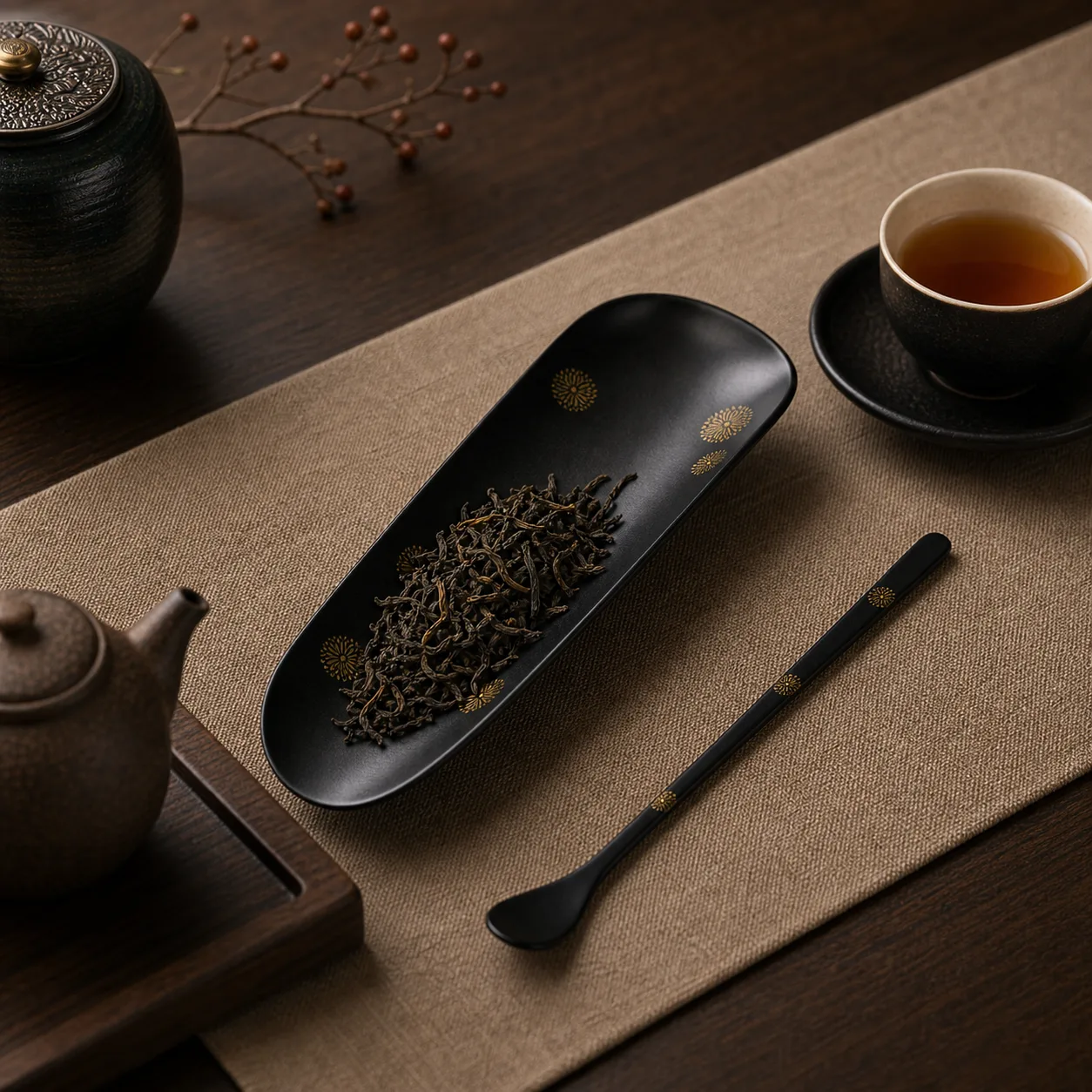
The tea scoop is one of the smallest objects on the gongfu tea table. It is also one of the most handled. Every session begins with it — measuring the leaf, transferring it from the caddy to the brewing vessel, setting the ratio that determines how the tea will taste.
Because it is used so often and held so closely, the tea scoop rewards attention. This guide covers the main materials, the forms that work best in practice, and how to choose one that fits your table and your brewing style.
What the Tea Scoop Does
The tea scoop — called a cha ze (茶則) in Chinese — has one primary function: to measure and transfer loose-leaf tea without damaging the leaves or contaminating them with odor from the scoop itself.
This second point matters more than it might seem. A scoop made from a material that absorbs or releases odor will affect the tea over time. A scoop with a rough surface will break delicate rolled oolongs or compressed pu-erh. A scoop that is too small or too large for the caddy opening makes the transfer awkward and imprecise.
The right scoop disappears into the session. You pick it up, measure the leaf, set it down. It does not require thought.
Materials
Bamboo is the most traditional material for tea scoops. It is lightweight, odor-neutral, and smooth enough not to damage leaves. Bamboo scoops are typically carved from a single piece, which gives them a natural variation in color and grain. They are the most common choice in traditional gongfu tea practice and remain the standard against which other materials are measured.
Wood — particularly hardwoods like walnut, rosewood, or ebony — produces scoops that are denser and heavier than bamboo. The weight gives them a different feel in the hand, and the grain patterns can be striking. Hardwood scoops are more durable than bamboo and develop a patina with use. They work well on tables where other wooden objects are present, creating a visual consistency.
Lacquered wood combines the warmth of wood with the smooth, sealed surface of lacquer. A lacquered tea scoop will not absorb moisture or tea residue, making it easy to clean and consistent in performance over time. On a table that already features lacquered objects — a tray, a waste bowl, cup coasters — a lacquered scoop creates a coherent aesthetic.
Ceramic and porcelain scoops exist but are less common. They are heavier, more fragile, and can chip if dropped. Their main advantage is that they are completely non-porous and easy to clean. They work well in formal or display contexts but are less practical for daily use.
Form
Tea scoops come in two basic forms: flat and curved.
A flat scoop — essentially a small paddle or spatula — is better for tightly rolled teas like ball oolongs, where you want to slide under the leaves rather than scoop through them. It is also easier to use with wide-mouthed caddies.
A curved scoop — with a slight bowl shape at the tip — holds the leaf more securely during transfer and is better for looser teas like white tea, green tea, or broken-leaf pu-erh. The curve prevents leaves from sliding off during the transfer from caddy to teapot or gaiwan.
Most practitioners eventually own both and choose based on the tea they are brewing that day.
How to Choose
Start with the tea you brew most often. If you primarily drink rolled oolongs or pu-erh cakes, a flat bamboo or lacquered wood scoop is the most practical choice. If you drink a variety of teas, a curved scoop in a neutral material like bamboo gives you the most flexibility.
Consider the other objects on your table. A lacquered scoop on a lacquered tray creates a unified surface. A bamboo scoop on a wooden tray feels natural and understated. The scoop does not need to match exactly, but it should not feel out of place.
Finally, hold it before you decide if you can. The balance of a tea scoop — how it sits in the hand, how the tip aligns with the caddy opening — is something you feel rather than see. A scoop that feels right will be used. One that feels awkward will be set aside.
Explore the tea scoops and ritual tools in MR.TEA Tea Ritual Tools — selected for daily use and made to last.