

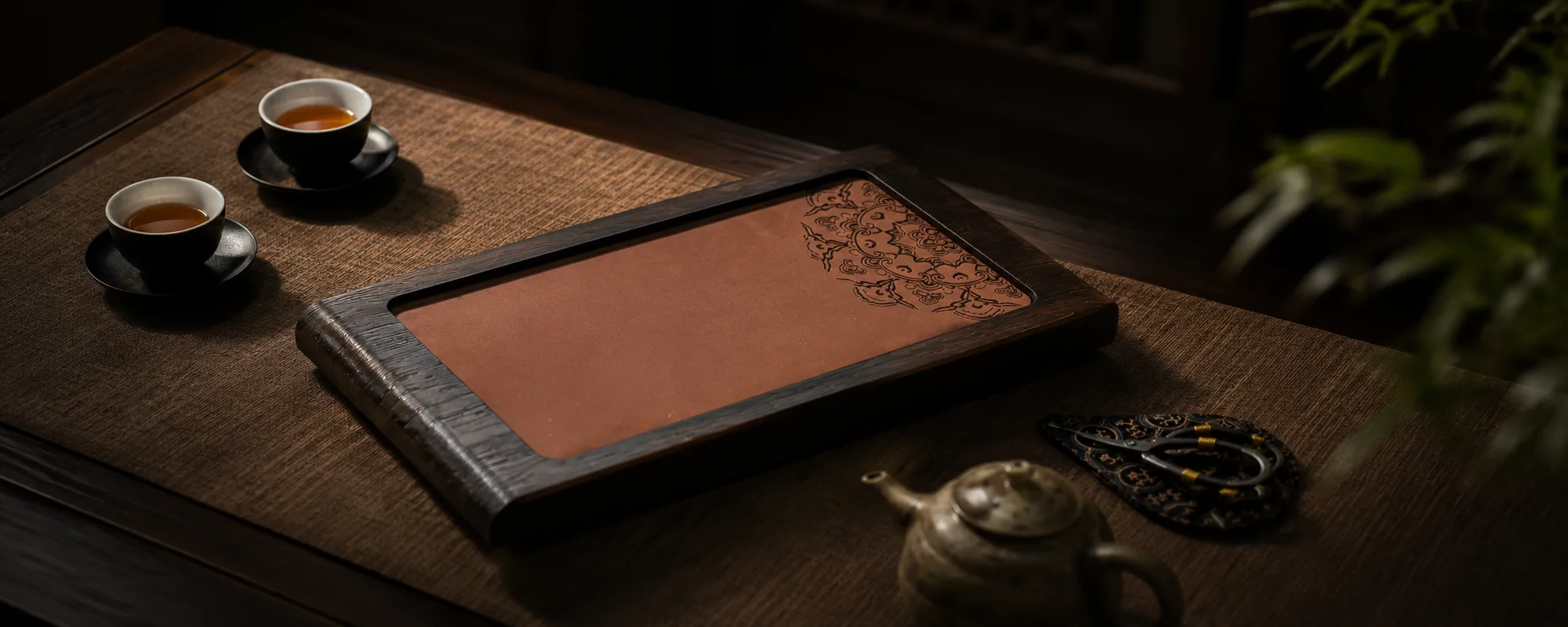
The tea tray is the foundation of the gongfu tea table. Everything else sits on it, around it, or in relation to it. Choosing the right tray shapes how your sessions feel and how your table looks.
The most important decision is not the material or the size — it is the style. Chinese tea trays come in two fundamentally different types: dry style and wet style. Understanding the difference will help you choose a tray that fits how you actually brew.
Wet Style Trays
A wet style tray has a hollow interior that collects water. The surface is slatted or perforated, and water drains through into a reservoir below. You empty the reservoir periodically during or after the session.
Wet style trays are forgiving. You can pour water freely over the teapot, rinse cups directly on the tray, and let water go where it goes. The tray handles it. For beginners, or for anyone who brews in a relaxed, generous way, a wet style tray removes one source of friction from the session.
The tradeoff is maintenance. The reservoir needs to be emptied and cleaned regularly. If neglected, it can develop odors. The drainage mechanism — usually a tube or plug — adds a small point of failure.
Dry Style Trays
A dry style tray has a solid surface with no drainage. Water is managed deliberately: you wipe the tray with a tea cloth, pour carefully, and keep the surface clean as you go.
Dry style brewing requires more attention, but it produces a different quality of session. Because you cannot pour freely, you become more precise. The tray stays cleaner. The surface — whether lacquer, wood, or stone — remains visible and unobscured by pooled water.
For lacquered trays in particular, dry style is the natural choice. The lacquer surface is part of the object’s beauty. A wet style approach would hide it under water and risk damage over time.
At MR.TEA, our tea trays are designed for dry style brewing. The lacquer finish, the proportions, and the surface texture are all calibrated for a session where water is used with intention rather than abundance.
Which Style Is Right for You?
The answer depends on how you brew and what you value in a session.
Choose a wet style tray if you brew in a generous, relaxed way and prefer not to think about water management. It is also a practical choice if you brew for guests frequently, where the pace of pouring is faster and less controlled.
Choose a dry style tray if you value the surface of the tray as part of the aesthetic, if you brew alone or in small groups, or if you want the discipline of careful water management to become part of your practice.
Most experienced practitioners eventually prefer dry style. The constraint becomes a pleasure.
Size and Proportion
Beyond style, size matters. A tray that is too small forces you to arrange your teaware awkwardly. A tray that is too large makes the session feel sparse and unanchored.
A good starting point: the tray should comfortably hold your teapot or gaiwan, a fairness cup, and four to six cups, with enough space around each piece that nothing feels crowded. For most home sessions, a tray between 30 and 45 centimeters in its longest dimension works well.
Material
Tea trays are made from many materials: bamboo, wood, stone, ceramic, and lacquer. Each has a different feel and a different relationship to water.
Lacquered trays are among the most refined. The lacquer surface is smooth, warm to the touch, and develops a subtle patina with use. It is resistant to water when properly cared for, and it ages in a way that makes the tray feel more personal over time.
Explore the dry style lacquer tea trays in MR.TEA Tea Trays — each one made for daily use and designed to last.