

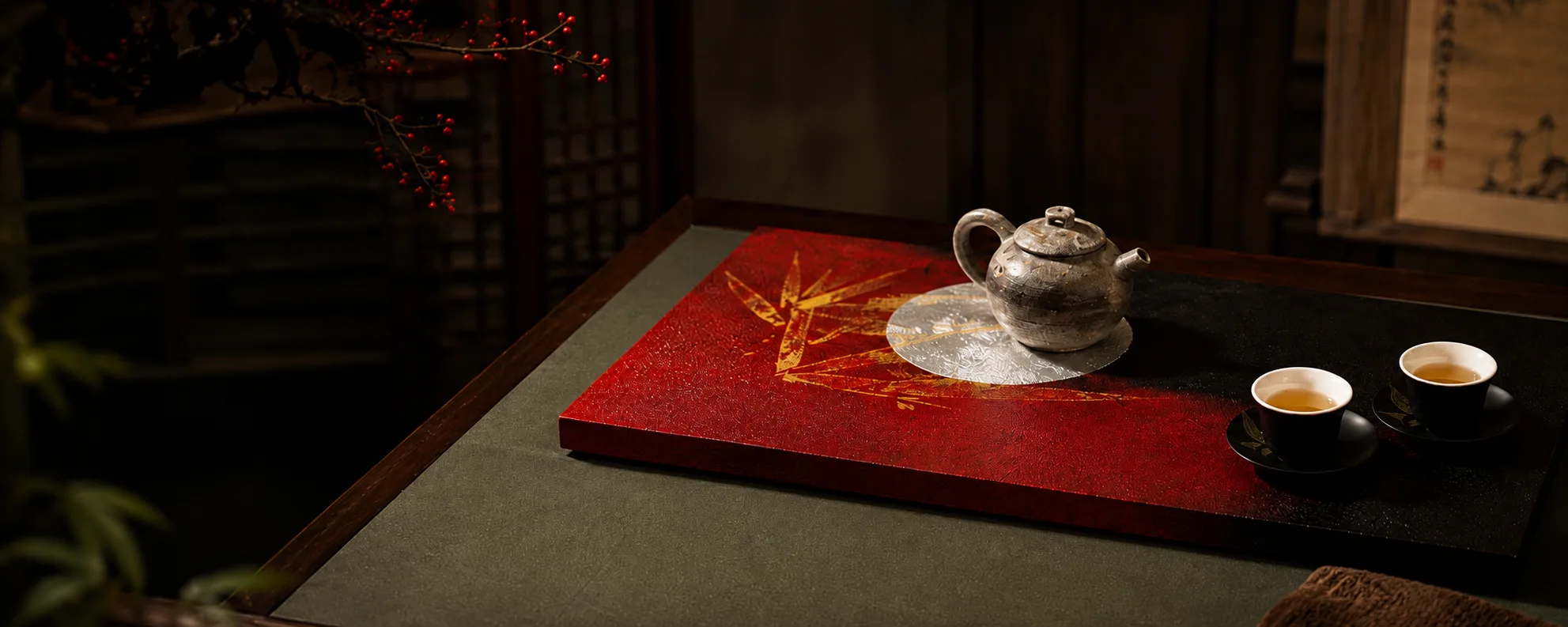
Chinese lacquerware has been made for more than three thousand years. It appears in tombs, in palace collections, and in museum cases around the world. It is also, increasingly, on tea tables — used daily, handled with care, and appreciated for the way it ages.
If you are new to lacquerware, this guide explains what it is, how it is made, what to look for, and how to care for it. It is written for people who are curious about adding lacquered objects to their tea practice, not for collectors or specialists.
What Is Chinese Lacquerware?
Lacquerware is made by applying the sap of the lacquer tree (Toxicodendron vernicifluum) to a base — usually wood, though sometimes bamboo, cloth, or a combination. The sap, called raw lacquer or shengqi, is toxic when wet but becomes hard, smooth, and durable when it cures in humid conditions.
Each layer of lacquer must cure completely before the next is applied. A finished piece might have ten layers, or thirty, or more. The depth of a lacquer surface — the way light seems to come from inside it rather than reflect off it — is a product of this layering.
Traditional Chinese lacquer (dà qī, 大漆) is distinct from the synthetic lacquers used in mass production. It is slower to make, more labor-intensive, and more responsive to use over time. A well-made lacquer piece develops a patina — a subtle deepening of color and surface — that makes it feel more personal the longer you use it.
Common Forms on the Tea Table
Lacquerware appears in many forms on the gongfu tea table. The most common are:
- Tea trays — the foundation of the table, used as a dry brewing surface for the teapot, gaiwan, and cups
- Tea waste bowls — used to receive spent water, warming rinses, and discarded first steeps
- Teapot rests — small platforms that lift the teapot off the tray surface and protect the lacquer from heat
- Cup coasters — placed under individual cups to protect the tray and add a layer of visual intention to each cup’s placement
- Tea scoops — used to measure and transfer loose-leaf tea from the caddy to the brewing vessel
Each of these objects is small enough to be practical and refined enough to reward attention. On a well-composed tea table, lacquered objects work together to create a surface that feels considered rather than assembled.
What to Look For
When choosing a lacquered tea object, a few things are worth examining.
The surface should be even — no bubbles, no visible brush marks, no areas where the lacquer has pooled or thinned. Run your finger across it. A well-finished lacquer surface feels smooth in a way that is difficult to describe but immediately recognizable.
The color should be consistent. Traditional lacquer colors — deep red, black, amber, and the dark tones produced by iron-finish techniques — should be even across the surface, with no fading or patchiness.
The base should feel solid. Lacquer applied to a poorly made wooden base will eventually crack or warp. A good lacquer piece starts with good material underneath.
How to Care for Lacquerware
Lacquerware is durable but not indestructible. A few simple habits will keep it in good condition for decades.
Wipe it with a soft, dry or lightly damp cloth after use. Do not soak it in water or leave water sitting on the surface for extended periods. Avoid harsh detergents, which can dull the finish over time.
Keep it away from direct high heat — do not place a very hot teapot directly on a lacquer surface without a rest underneath. Prolonged exposure to strong sunlight can cause fading.
Beyond these precautions, the best thing you can do for a lacquer piece is use it. Regular handling and gentle cleaning are what allow the patina to develop. A lacquer object that sits unused in a cabinet does not age the same way as one that is part of a daily practice.
Starting with Lacquerware
If you are new to lacquerware, a tea waste bowl or a set of cup coasters is a good place to start. Both are used in every session, both are small enough to examine closely, and both give you a sense of how lacquer feels in daily use before you invest in a larger piece like a tray.
Explore the lacquered tea objects in MR.TEA Lacquered Tea Objects — each piece selected for daily use and made with traditional Chinese lacquer on a wooden base.